
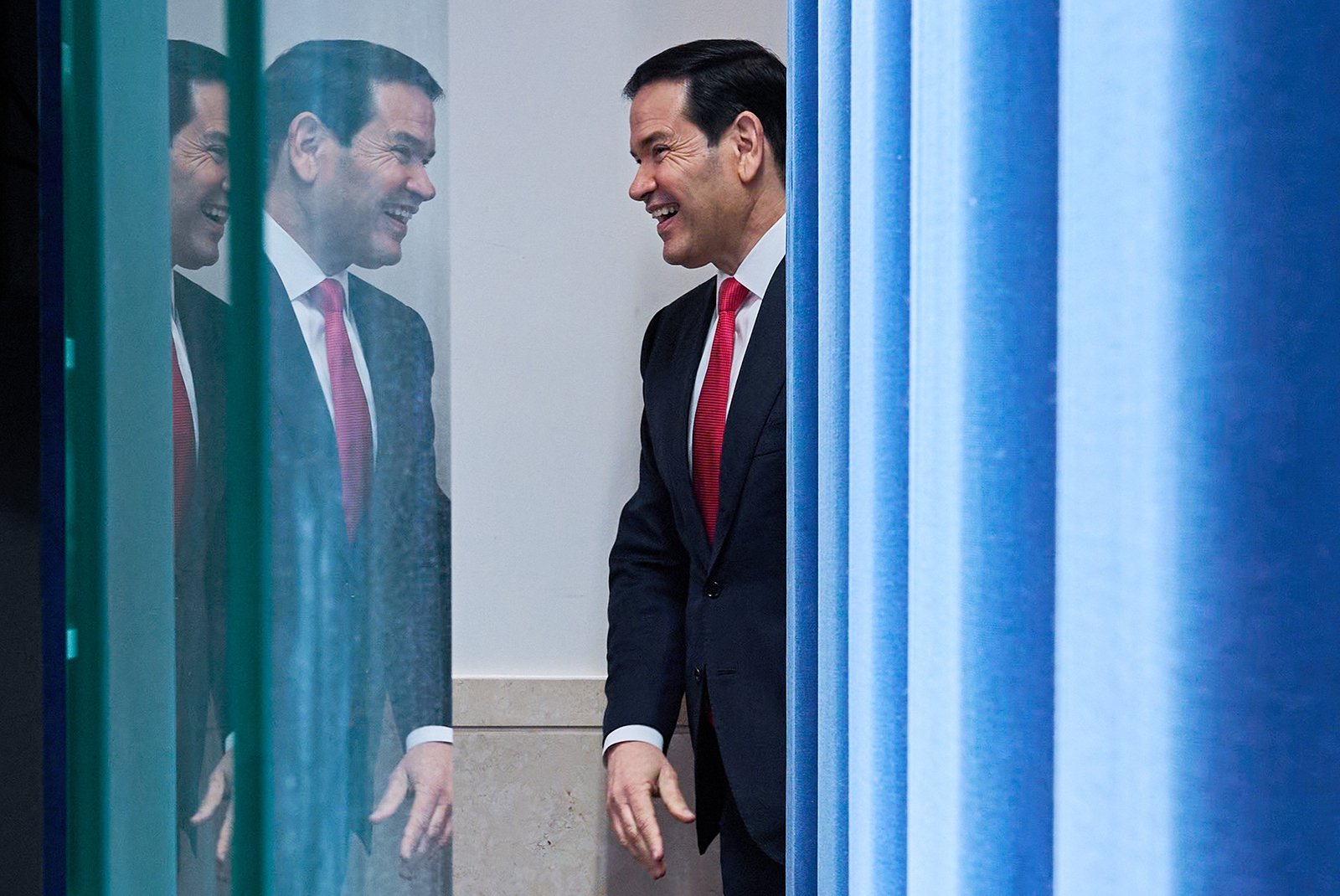
(RNS) — Shortly after Pope Leo XIV was elected last May, Secretary of State Marco Rubio, himself a Catholic, was asked about his thoughts on the newly minted pontiff’s comments signaling deep concern for immigrants. After defending President Donald Trump’s mass deportation efforts — which Pope Leo would end up publicly criticizing — Rubio, the son of immigrants, downplayed the pope’s political relevance.
“I don’t view the papacy as a political office,” Rubio said. “I view it as a spiritual one.”
But when asked by White House reporters on Tuesday (May 5) about his meeting with the pope slated for later this week, the secretary suggested Leo may have significant political cachet after all.
“The pope is obviously the Vicar of Christ, as a Roman Catholic, but he’s also the head of a nation-state,” Rubio said, outlining his hopes for partnering with the Holy See on various topics, such as religious liberty. “It’s an organization that has a presence in over 100-something countries around the world, and we engage with the Vatican quite a bit because they’re present in many different places.”
The shift hints at the unusual, and unusually contentious, relationship the Trump administration has forged with the Vatican under Pope Leo, a dynamic that Rubio — arguably the second most prominent Catholic in the president’s Cabinet, after Vice President JD Vance — will be forced to navigate even after his meeting with Leo. It is perhaps an especially tricky task for Rubio, who has insisted the church played a major role in the U.S. founding and who has invoked Catholicism while defending U.S. policies criticized by multiple popes.
Navigating tensions between the White House and the Vatican is certain to color Rubio’s conversation with Leo, which U.S. officials have said they expect to be “frank.”

President Donald Trump on April 12, 2026, left, and Pope Leo XIV on March 31, 2026. (AP Photos)
Last fall, Leo, the first U.S.-born pope, referred to the treatment of immigrants in the U.S. under Trump as inhumane and called for the U.S. government to allow faith leaders greater access to immigrant detainees. Leo has also criticized the war in Iran in recent weeks, calling on Americans — as well as citizens in other countries involved — to contact their government leaders and say “we don’t want war, we want peace.”
The pope’s comments have, in turn, sparked backlash from Trump, who decried the pontiff as “weak on crime” in a lengthy social media post. Trump has also suggested Leo’s views on foreign policy are “endangering a lot of Catholics and a lot of people,” and that the pontiff wants Iran to have a nuclear weapon.
The public back-and-forth continues to rage as of Wednesday, when Leo was asked about Trump’s latest comments by reporters outside the papal residence.
“The mission of the church is to proclaim the gospel, to preach peace,” Leo said. “If someone wants to criticize me for proclaiming the gospel, let them do so truthfully. For years, the church has spoken out against all nuclear weapons, so there is no doubt on that point.”
It would be a delicate situation for any secretary of state, but perhaps especially for Rubio, who has spoken about his faith publicly on numerous occasions. Although he has said that, as a Catholic, he supports “100%” the teaching authority of the church, when Pope Francis issued encyclicals and apostolic exhortations that called for action on climate change and criticized trickle-down economics ahead of the 2016 election, then-Republican presidential candidate Rubio insisted the pope only has authority on some topics.
“On moral issues, he speaks with incredible authority,” Rubio told Fox News in 2015. “He’s done so consistently on the value of life, on the sanctity of life, on the importance of marriage and on the family. On economic issues, the pope is a person.”

Pope Leo XIV meets the Algerian community in the Basilica of Our Lady of Africa in Algiers, April 13, 2026, on the first day of an 11-day apostolic journey to Africa. (AP Photo/Andrew Medichini)
It’s unclear how Rubio’s same argument would play with Leo on issues such as immigration and war. The pope recently decried Trump’s threat to eradicate Iran’s entire civilization as “truly unacceptable” and railed against the politicization of religion last month during a visit to Cameroon.
“Woe to those who manipulate religion and the very name of God for their own military, economic and political gain, dragging that which is sacred into darkness and filth,” Leo said.
Even so, Rubio may hope to avoid controversy as much as possible. He suggested during his discussion with White House reporters that he is interested in potential partnerships with the Vatican that involve protecting persecuted Christians abroad and distributing humanitarian aid to Cuba through the Catholic Church.
“We’re willing to give more humanitarian aid to Cuba … distributed through the church, but the Cuban regime has to allow us to do it,” Rubio said. “They won’t allow us to give their own people more humanitarian aid, and we’re willing to do it through the church.”
Bolstering Vatican ties may push Rubio to draw on his Catholic faith during his meeting with Leo, which the secretary has said was planned before the heated exchanges between Trump and the pontiff made international headlines. And the meeting comes at a time when Rubio appears to be leaning into his Catholic roots: On Monday, Republican National Committee spokesperson Kiersten Pels said in a tweet that she has seen Rubio at Catholic services regularly.

Secretary of State Marco Rubio arrives at the West Wing of the White House in Washington, April 23, 2026. (AP Photo/Jacquelyn Martin)
Reached by Religion News Service on Wednesday, Pels declined to name publicly which church Rubio attends, citing security concerns. But she said she has spotted the secretary at a Washington, D.C., church for months during midday and evening Masses, describing him as quiet and “humble” during services.
The secretary’s re-embrace of Catholicism is the latest chapter in his complicated religious journey. Although he was baptized Catholic and wrote in his 2012 memoir about being “once a Catholic, always a Catholic,” in his youth Rubio was also briefly a member of The Church of Jesus Christ of Latter-day Saints. He later recanted his ties to the LDS church, but is known to have attended services at a Southern Baptist Church in Florida as recently as 2015, when he was running for president.
His affiliation with both traditions eventually spurred some, such as New York Times religion columnist Mark Oppenheimer, to ask: “Marco Rubio: Catholic or Protestant?”
Rubio has said he read the “entire catechism of the Catholic Church” between 2004 and 2005, while reacquainting himself with the tradition, and has since made his faith a bigger part of his public persona. When he delivered a speech in 2019 at the Catholic University of America’s Busch School of Business, he framed his remarks around an encyclical by Pope Leo XIII — the same pope from whom the current Pope Leo draws inspiration.
And Rubio also appealed to his faith last month during a pretaped speech shown during a conference organized by the Center for the Constitution and the Catholic Intellectual Tradition. While discussing the 250th anniversary of the signing of the Declaration of Independence, Rubio acknowledged that only one of the signers was Catholic but argued that Catholicism was interwoven with U.S. history.
Standing in front of a State Department logo, Rubio pointed to the influence of Catholics in establishing colonialist projects in what eventually became the U.S., such as Christopher Columbus and Spanish settlers who established cities such as St. Augustine in what is now Florida. Rubio then argued that the U.S. founding wasn’t “merely a brainchild of the Enlightenment” or a “radical rupture with the past,” but an outgrowth of broader efforts ushered in by Catholicism.
The American political system, he said, “belongs to the same civilizational tradition that produced the towering cathedrals of Rome and the philosophy of Augustine and Aquinas. America was a gift, where the church and the civilization it made was reborn, discovering itself anew in the wilderness.”
He added: “To look upon the history of this golden land is to see the face of God.”
It’s an open question whether Pope Leo, who has been stridently critical of nationalism, would agree. But Rubio, who appears to be eyeing a healthier — or at least less contentious — relationship with the Vatican, may be hoping the pope at least sees the U.S. secretary of state as a potential partner.
