
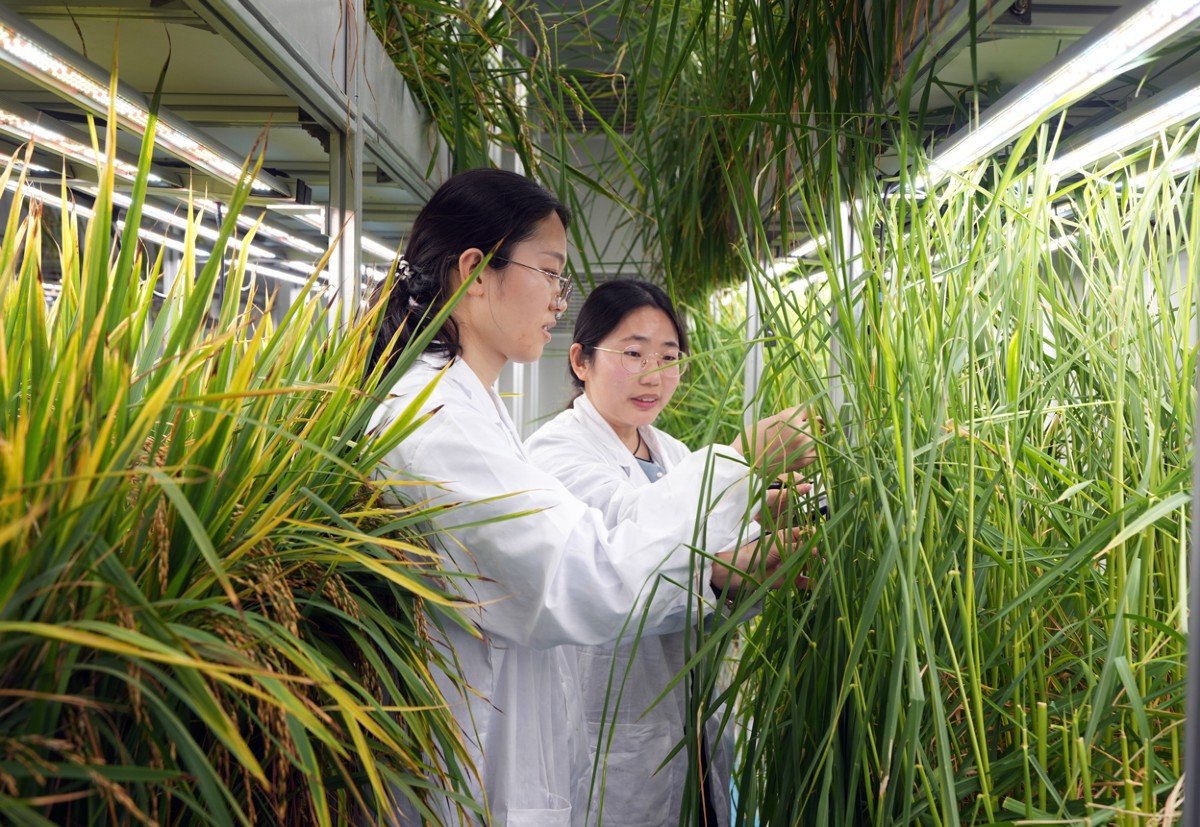

A new study shows most elite researchers in China remained in the country over the course of their careers.Credit: An Yuan/China News Service/VCG/Getty
Deng Xiaoping’s 1979 visit to the United States heralded a new era of economic and scientific exchange between China and the United States. Xiaoping, then the leader of the Chinese Communist Party, famously donned an iconic cowboy hat at a rodeo in Simonton, Texas. Simon Marginson, a social scientist at the University of Bristol, UK, describes the trip as “rapport-building”, cementing the return of full diplomatic relations after a long period of hostility.
When Cong Cao, a social scientist at the University of Nottingham in Ningbo, China, decided to investigate the bibliographic impact of the new US–China relationship, he expected that foreign-educated academics would have increasingly important roles as elite members of China’s scientific academies. He covered the subject in his PhD thesis1 and in a 2004 book called China’s Scientific Elite.
A study, published in Nature Human Behaviour and co-authored by Cao, found that China’s opening in the late 1970s and 1980s did indeed bring US and Chinese researchers together, and that Chinese scientists who worked in both countries were more likely to become mid-level or senior researchers at both elite and non-elite universities in China2, but that this cross-fertilization is not reflected in China’s elite science academies.
The authors found that a greater percentage of elected members of the Chinese Academy of Sciences (CAS) and the Chinese Academy of Engineering (CAE) had obtained their PhDs from the 1980s onwards in China rather than the United States, says Cao. Domestically educated scholars now predominate in the leadership of Chinese universities, the authors write, adding that this trend arises “from the practice of appointing academicians to these positions and the prevalence of these scholars within the elite echelons”.
In the past year, increased hostility between China and the administration of US President Donald Trump seems unlikely to increase opportunities for scholars who have bounced between both countries to reach senior positions in either, sources say.
Booming science
The authors point to China’s “worrisome” trend in undervaluing foreign education, a move “considered less conducive to institutional reforms and the attraction of talent from abroad”. But they concede that this decline is because of China’s growing strength in higher education and research capabilities.
Indeed, China’s global ascent in science is reflected in a Nature Index ranking of countries by their research output, in which it now holds the top slot. The CAS is the world’s leading institution in another Nature Index ranking of institutional output of scientific research in premier journals.
The shift to domestically obtained PhD-holders, says Cao, reflects a move towards scientific isolationism. The study’s other authors were historian Jianan Huang and social scientist Hong Liu, both at Nanyang Technological University in Singapore.
To understand such trends, the researchers examined profiles of some 3,534 members of Chinese academies, including the CAS and the CAE, spanning 1905–2023.
Although there were more in-depth exchanges between China and the rest of the world after the 1910s, the researchers found that the proportion of Chinese academics who obtained their highest degrees at elite US universities — such as the Massachusetts Institute of Technology in Cambridge, Yale University in New Haven, Connecticut, and Princeton University in New Jersey — or prestigious UK institutions, including the University of Cambridge and the University of Oxford, who were elected to the CAS or the CAE started to decline in the 1980s.
Despite some variability over the decades, the researchers found that, by as recently as 2023, more than 82% of the CAS and the CAE’s elite scientists had earned their highest degrees at Chinese universities.
Shifts in recruitment
Academies are also selecting fewer academics from developed countries as foreign members. In 1994, for example, 88% of foreign academics elected to the two academies were from the United States. In 2023, that figure dropped to only 21%.
Modern China’s foreign policy is partly focused on building trade infrastructure and funding projects in other nations, a raft of policies and investments known collectively as the Belt and Road Initiative. This has opened up opportunities for academics in developing countries, the authors write. China has even established preferred-treatment policies encouraging nominations among these individuals, “even though foreign members [from developed countries] tend to outperform their counterparts from developing countries”, the authors note.
When the CAS and the CAE started accepting foreign membership in the mid-1990s, most members were either from the Chinese diaspora or foreign academics who had earned prestigious awards or membership in science academies in their own countries, write the authors.
The elite membership of the national academies is also trending away from China’s more socially advantaged regions to more representatives from the less-developed western part of the country, in what the authors attribute, in part, to efforts promoting inclusion in the country. Overall, about 25% of members have not participated in full-time research overseas, the authors report.
On the face of it, Britta Glennon, an economist at the Wharton School at the University of Pennsylvania in Philadelphia, doesn’t think that the 25% figure reflects any weakness in the country’s research system, given its emergence as a major scientific power with “deep research capacity”. But to her, it could be a sign of less interest in international engagement.
“We know from research that reduced international cooperation is bad for science,” she says. A pattern of diminished international engagement, she adds, “would have implications not just for China, but for global scientific progress”.
Another sign that the country is turning inwards is its encouragement that academics publish some of their research in local journals, written in Chinese — a move that the authors say “may erode elite academics’ willingness to return”.
Gi-Wook Shin, a sociologist at Stanford University in California, whose 2025 book The Four Talent Giants explores the intermingling of geopolitical forces and strategies for attracting talent in China and other countries, has heard from his former students about changes in which journals they’re expected to publish in.
When these students first returned a decade or so ago to China, promotions and tenure were tied to getting published in English in top journals in the West. In the past five to seven years, he explained, they’re being pressured to publish in Chinese. “If they don’t, they’re being politically criticized,” he says.
That doesn’t mean that they have to stop publishing in English, according to Marginson. They’re expected to do both, which “doubles the workload”, he says.
