
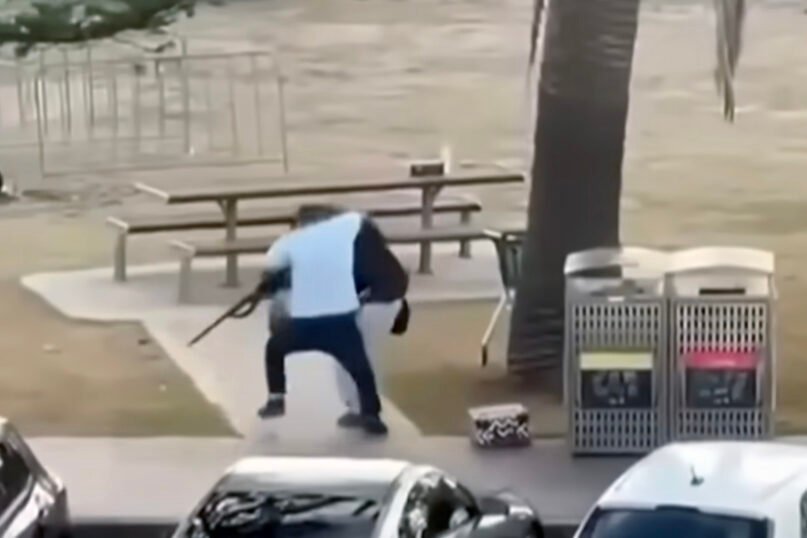
(RNS) — The truth about a society often reveals itself in moments of crisis, in the unscripted actions of ordinary people. On Sunday (Dec. 14) in Sydney, when gunmen opened fire on a Hanukkah celebration at Bondi Beach, it was Ahmed al Ahmed, a 43-year-old Syrian-born Muslim and Australian immigrant, who ran toward danger. He tackled and disarmed one of the attackers, likely saving countless lives, and was lauded by Australian leaders and global onlookers as a hero.
Almost immediately, parts of the far-right internet went to work erasing that reality. Influencers and commentators fond of Islamophobic narratives began insisting, without evidence, that Ahmed must be a Christian. Laura Loomer, one of MAGA’s boundary guardians, wrote on X: “Credible reports suggest the man is actually a Lebanese or Coptic Christian. Don’t fall for the propaganda.”
These influencers could not tolerate the simple fact that a Muslim man risked his life to protect Jewish lives. It was too inconvenient for their worldview.
On the same day, two students were shot at Brown University. As speculation swirled online, some voices expressed open hope that the shooter would turn out to be Muslim. They needed the tragedy to fit their narrative; proving that he was shouting “Allahu Akbar” would allow them to spin it their way. Yet Mukhammad Aziz Umurzokov, one of the two students who were killed, was a Muslim himself. The fact received little attention from those who had been so eager to assign blame.
This is the dangerous core of Islamophobia today: The prejudice is so entrenched that reality must bend around it. Heroes must be stripped of their Muslim identity. Victims must be reframed as perpetrators. Truth becomes secondary to usefulness.
I have experienced this dynamic firsthand. A short, heavily edited clip of me continues to circulate on right-wing accounts designed to misrepresent my stance and inflame anti-Muslim sentiment. This is how manufactured outrage works. The few seconds shown in the clip are divorced from their context, allowing the confected narrative to take hold.
This is not accidental. Islamophobia is a political industry that depends on constant fear, distortion and dehumanization. Nor is it only a domestic political weapon, but a global information strategy. In the United Kingdom, Tommy Robinson, founder of the English Defense League, continues to build a movement around portraying Muslims as incompatible with Western society, using exaggeration, fabrication and selective storytelling.
Multiple investigations and analyses show how anti-Muslim sentiment is deliberately amplified to distract from mass violence and suppress criticism. One exposé found that the Israeli Ministry of Diaspora Affairs funded online influence campaigns that pushed pro-Israel messaging alongside anti-Muslim content. The goal was to shape public opinion by portraying Muslims as inherently threatening, making it easier to deflect attention from atrocities in Gaza.
Scholars analyzing the rhetoric around Gaza argue that Islamophobia is central to rhetoric attempting to justify or minimize Palestinian suffering by reframing the structural realities of occupation and mass death as natural responses to an inherently barbaric people. Civil rights advocates have warned that some pro-Israel political actors are using Islamophobia to discredit critics, distract from documented war crimes and frame solidarity with Palestinians as extremism.
Western media outlets, in addition, often rely on Islamophobic framing when covering Gaza, sidelining Palestinian voices while centering narratives that serve power rather than truth, according to reporting by the Bridge Initiative at Georgetown University.
These studies show that Islamophobia is not a byproduct of confusion or lack of education about Islam. It is driven and amplified by a recognizable cast of figures and platforms. Far-right provocateurs such as Loomer make conspiratorial claims about Muslims, painting an entire faith community as a national security threat and pushing false narratives to millions of followers.
These figures cultivate an audience conditioned to believe Muslims are uniquely violent or suspect. So when someone like Ahmed al Ahmed acts like a hero in Sydney, the system malfunctions. The narrative must be rewritten.
Once a community is dehumanized digitally, it becomes easier to continue to marginalize, exclude or harm that community physically. But the truth must break through.
Ahmed al Ahmed did not stop to ask the religion of the people he shielded. He acted on faith, courage and conscience. He has been rightfully recognized widely for the hero he is despite constant attempts to vilify his community.
This is the crisis of our moment: When a Muslim is a victim, their humanity is erased; when a Muslim is a hero, their identity is erased.
Islamophobia thrives on erasure. It thrives on fear. It thrives on distortion and distraction. But narratives built on fear are brittle when confronted with truth. Muslims today are part of the social fabric of every place they call home. They are students, caregivers, neighbors and, yes, heroes. Their courage and compassion defy bigotry’s attempts to confine them to caricature.
If we want a society worth living in, then truth must matter more than fear. Heroism must matter more than narrative convenience. And human dignity must matter more than political utility.
The Islamophobia machine is in full swing, but the truth keeps clogging its system.
