
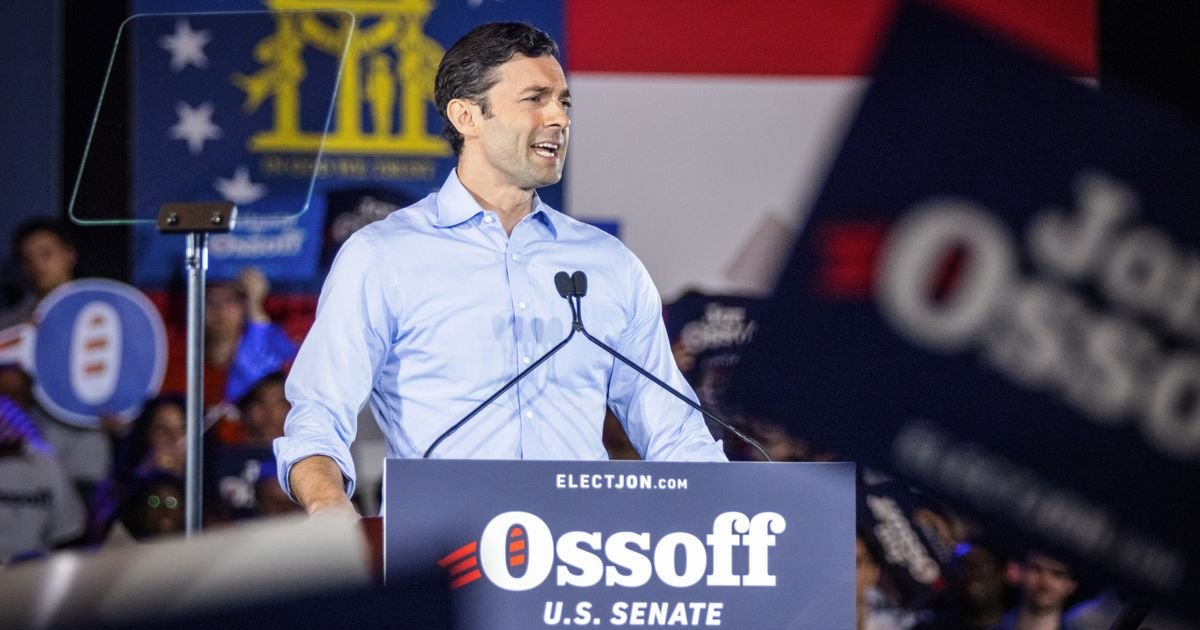

Embattled Democratic senator Jon Ossoff of Georgia is now looking like a favorite for reelection.
Photo: Dustin Chambers/Bloomberg/Getty Images
When you’re on the crest of an electoral “wave,” all sorts of wonderful things seem possible. That’s increasingly true for Democrats as they prepare for the 2026 midterms. Fed by positive results in many 2025 and 2026 elections, Democrats are optimistic about flipping control of the House and even perhaps the Senate. And now they’re envisioning geographic gains that might have long-term significance. This week, the Democratic National Committee released a memo boasting of the party’s success in the South, a region that has been largely dominated by Republicans in the 21st century. Some of the recent electoral success stories touted by the DNC — in Alabama, Florida, Georgia, Kentucky, Louisiana, Mississippi, Tennessee, Texas, and Virginia — were not wins but gains (e.g., overperformance by a losing mayoral candidate in Mobile). But certainly, a true national Democratic wave will lift boats nationwide.
If Democrats want to flip and hold the U.S. Senate and win future presidential elections, it is indeed important that they find ways to challenge Republican hegemony in the former Confederacy. There have been some important signs of revival for southern Democrats. As recently as 2014, a New York Times headline concluded that the “Demise of the Southern Democrat Is Now Nearly Complete.” But in the Trump era, Georgia and North Carolina have emerged as classic battleground states with competitive races at every level; Democratic governors are in place in Kentucky, North Carolina, and Virginia; and Democrats could come out of the midterms with as many as six U.S. Senate seats in the region.
The slow and partial Democratic revival in the South is not just a replay of previous party comebacks. Successful southern Democrats these days aren’t “ConservaDems” who take the party base for granted and co-opt quasi-Republican positions on controversial issues. In Georgia, for example, U.S. senators Raphael Warnock and Jon Ossoff almost never seek to distinguish themselves from the national party. Even Democrats with firm “centrist” identities like Kentucky governor Andy Beshear, North Carolina governor (and 2026 Senate nominee) Roy Cooper, and Texas Senate nominee James Talarico are in line with party orthodoxy on most issues. Southern Democrats are no longer a faction but instead represent one regional outpost just like others. So performing better in the South doesn’t require the sorts of ideological accommodations once so common whenever Democrats chose to focus on the region. Of equal importance, non-white Democrats are increasingly an integral part of the party base in southern states, while in the past they were often asked to support white politicians who did not really share their views or values.
Make no mistake: Southern Democrats are still facing a tough battle and truly have been reduced to relative insignificance in a number of states, such as Arkansas, Tennessee, and South Carolina. But things are broadly looking up for southern Democrats in 2026, and there are four high-profile opportunities worth highlighting.
On April 21, Democrats face a huge moment in one of their strongest states in the region. The Democratic-controlled legislature and newly elected Democratic governor Abigail Spanberger are sponsoring a special election to obtain voter approval of a constitutional amendment that would allow them to temporarily gerrymander the Commonwealth’s 11 U.S. House districts. Under their proposed map, as many as four GOP-controlled congressional seats could flip in November, which at a minimum would offset Republican plans in Florida to conduct a congressional gerrymander during a special legislative session later this month.
This is a very big deal for Democrats nationally, but also for Virginia Democrats specifically; the success they enjoyed in last year’s off-year elections for governor and the legislature could be reversed if the gerrymandering referendum fails. Early voting and polling indicate a close outcome, and both parties are going all out. Despite the current Democratic trifecta in Virginia, the state remains far more competitive than California, where a similar gerrymandering permission slip was overwhelmingly approved by voters last November. So the results on April 21 will justly draw enormous attention.
Perhaps the single ripest opportunity for Democratic gains in the U.S. Senate is in North Carolina, where the seat of retiring Republican Thom Tillis will go to either former two-term Democratic governor Roy Cooper or Trump loyalist and former RNC chairman Michael Whatley. Cooper’s candidacy was a huge recruiting coup for Senate Democrats, and he has led the relatively little-known Whatley in 11 straight public polls dating back to last summer (most recently, Quantus Insights showed Cooper leading by a 49 percent to 44 percent margin as of April 1). The Democrat has also maintained a robust fundraising advantage up until now. But a recent plan published by the official Senate GOP super-PAC showed a commitment of $71 million on behalf of Whatley, the second-highest outlay in the country.
North Carolina has been a closely divided and hyperpolarized state throughout the Trump era, though the 47th president himself carried it three times. This race should come down to the wire, and if Cooper maintains his current lead, it probably reflects a pretty strong national Democratic wave.
After Trump carried Georgia in 2024, there was a general feeling that the GOP’s long-standing hold on the state — shockingly interrupted by Democrats in 2020 — might resume. But 2026 is shaping up into a potentially good Democratic year, in no small part thanks to Republican infighting.
Jon Ossoff won his seat by an eyelash in 2020 and was thought to be the most vulnerable incumbent Democratic senator this year. But he’s built up a large campaign war chest for reelection ($25 million as of early February). Despite a liberal-for-Georgia voting record, Ossoff’s job-approval ratio was plus-18 percent at the end of 2025, per Morning Consult.
Republicans are dealing with a three-candidate primary that on May 19 is very likely to produce an expensive and potentially fractious June 16 runoff. With Trump’s popularity in the state and nationally flagging this year, it doesn’t help that the Senate candidates (especially congressmen Mike Collins and Buddy Carter) are engaged in MAGA one-upmanship. Nobody thinks former football coach Derek Dooley has much of a chance to win the nomination, but his backing from powerful lame-duck governor Brian Kemp seems unshakable. Ossoff has consistently led all three Republicans in public polls, though not by any impressive margin.
The battle to identify a Republican successor to Kemp has become toxic. The GOP race originally looked like a high-stakes battle between state lieutenant governor and Trump loyalist Burt Jones and one of two opponents of Trump’s effort to overturn Biden’s win in the state in 2020: Secretary of State Brad Raffensperger (who certified Biden’s win and earned eternal MAGA enmity) and State Attorney General Chris Carr. Instead, the contest was turned upside down by the late entry of billionaire health-care executive Rick Jackson, who has gone after Jones with a huge barrage of vicious ads calling him a crook and a deadbeat. Jackson is also posing as more of an authentic MAGA champion than Jones, who has been endorsed by Trump, and is apparently trying to talk the president into a dual endorsement that makes him essentially neutral. This contest will almost certainly go to a wildly expensive and fractious runoff assuming Jackson makes the cut; he quickly took the lead in polling after the noisy launch of his campaign (marked by an ad that referred to Raffensperger as “Judas”).
All the GOP infighting has given fresh hope to Georgia Democrats, who have their own large and less divided gubernatorial field. Right now, that race is basically a multi-candidate competition (which notably includes former Republican lieutenant governor Geoff Duncan, who endorsed Kamala Harris in 2024 and then switched parties) to see who can make a runoff against former Atlanta mayor Keisha Lance Bottoms.
The nasty Senate battle in Texas this year could end with four-term Republican John Cornyn losing his seat to a MAGA wild man or (believe it or not) a Democrat. Cornyn and hard-right Texas attorney general Ken Paxton are facing a May 26 runoff after the incumbent narrowly ran ahead of the challenger in a March primary on a vast wave of heavy campaign spending. Donald Trump has promised to endorse one of them (after being begged on bended knee by Senate Republicans to save Cornyn) but hasn’t so far and may not do so at all. Cornyn still has the ability to spend even more money, and Paxton’s right-wing following could give him an advantage in a low-turnout runoff right after Memorial Day.
Either way, a good vicious end to the GOP primary (Cornyn in particular has called Paxton every name in the book) is good news for Democratic nominee James Talarico, who showed his political chops in upsetting the better-known social-media star Jasmine Crockett in a March primary. Republicans have already begun working to undermine Talarico’s signature religious branding by essentially denouncing the mainline Protestant as a heretic, and he has some real vulnerabilities. But he’s the best hope in years for a Lone Star Democratic breakthrough.
