
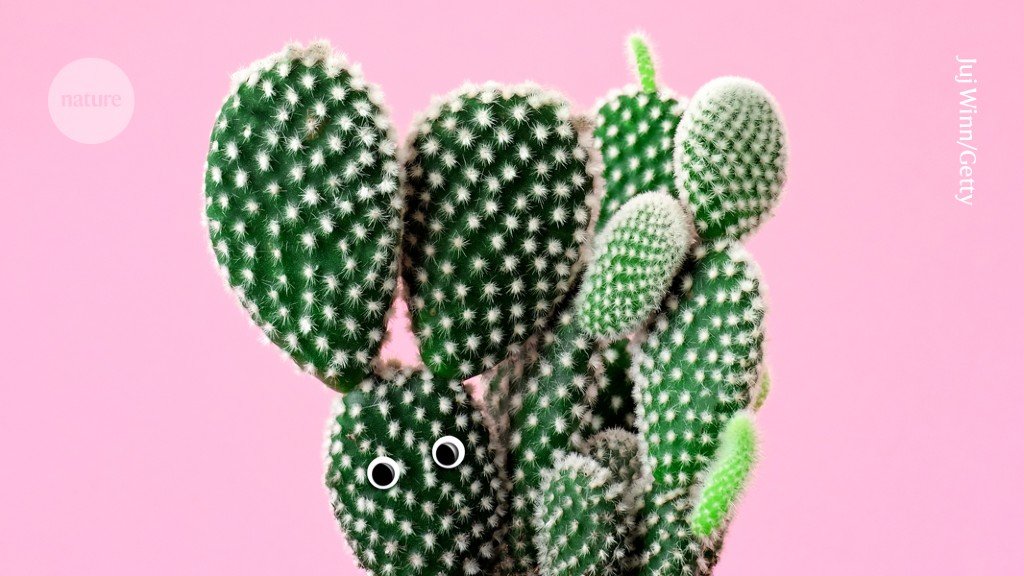

Harmless lab pranks, such as spraying objects with unexpected scents or adding googly eyes, can lift spirits and encourage research-group bonding.Credit: Juj Winn/Getty
On 1 April 2022, John Prensner, then a postdoctoral researcher in cancer biology, received a surprising letter. Typed on official-looking letterhead paper, the message outlined plans for a Smithsonian Institution exhibit dedicated to the Human Genome Project, which in 2001 produced the first draft sequence of the human genome. Through professional connections, the writer said, they had learnt that Prensner held a piece of that history on his lab bench at the Broad Institute of MIT and Harvard in Cambridge, Massachusetts: a PTC-200 machine used for PCR reactions during the pioneering work.
The machine had been inherited from a colleague at the nearby Whitehead Institute, where much of the project’s research was done, and was a favourite of Prensner’s because it was so simple to operate. He used the PTC-200 exclusively, and by then it was nearly as old as he was. When it finally stopped working, Prensner took the machine apart to try to fix it. But it never woke again, collecting dust until the letter arrived. “I wouldn’t get rid of it because I loved it so much, so I was excited that it might get a second life,” he says. “Until I turned the letter over.”
On the back, the letter stated that the Smithsonian was also interested in antiquated sound technology, including Prensner’s barely functioning 1995 boom box. Tipped off by the halo of labmates lurking surreptitiously around him, he soon realized that the whole thing was probably a prank. “Fortunately, the lab had a very positive atmosphere, so there weren’t any ill feelings,” Prensner says, adding that when he left in 2023 to start his lab at the University of Michigan Medical School in Ann Arbor, he trashed the PCR machine, but kept the boom box and letter.
Say what? The principal investigators who pass down wisdom through humour
Practical jokes such as this play out in labs every day, and many live on as group lore, stretching across generations of students and staff. Pranks, it turns out, are about much more than a laugh, and can serve important purposes — as tools for community-building, creative outlets in an otherwise intense working environment and as a means of passing on guidance. And although jokes can take nearly any form, there are underlying rules that define if and when pranking is appropriate. (Lab safety comes first: no researchers or experiments were harmed by these pranks.)
“The basis of a good prank is that you have to like and respect the person you’re pranking,” says Jess McLaughlin, who once hid tiny plastic horses they had found in a box on the kerb all throughout their lab when they were doing a genomics postdoc at the University of California (UC), Berkeley. “You’re not there to cause someone distress — you’re doing it with the person rather than to them.”
A prankster’s playbook
Some scientists, including McLaughlin, approach pranking opportunistically — striking when the Universe provides. Others pursue it with intention. Monica Tomaszewski , a programme manager at the University of Pittsburgh in Pennsylvania, recalls glueing down teachers’ chalk at school, but her pranking talents truly blossomed during her PhD at the same university. There, she discovered that her adviser, who is now retired, had a similar sense of humour. Because he was Canadian, Tomaszewski planned a prank to make his office smell like maple syrup. She bought candle-scenting solution, and each spring, applied it to his radiator, where he kept a collection of some 70 cacti.
What happens in our brains when we’re trying to be funny
“His office would smell like syrup for a few weeks, and he had no idea why,” Tomaszewski says. But one day, he quietly shared his suspicions with her — that his cacti were going into heat and releasing pheromones. “It was such a ridiculous sentence, because cacti don’t have a mating cycle, and he is a very intelligent biologist,” she says. Tomaszewski nearly gave away the prank then and there, but ultimately kept it up — even passing the scenting solution to lab colleagues when she moved on — before finally confessing over lunch one day several years later.
This idea of ‘pranking up’ — targeting people in positions of authority — is one of the many unspoken rules of practical jokes, alongside pranking laterally by targeting friends and peers. But to a fault, researchers who spoke to Nature say that pulling pranks on people over whom you hold power is poor form.
Social cues also determine whether pranking is appropriate. Jennifer Phillips, a research associate in genetics at the University of Oregon in Eugene, says that it often comes down to whether it’s “the right time, in the right place, with the right people”. Not all labs embrace a culture of pranking, and group dynamics are constantly in flux as people come and go. But when Phillips joined the university for her PhD in 1998, “the lab was made up of a unique group of people who really put fun in the centre of the table”, she says.
An ongoing prank involved the timers used to track experiments. Good etiquette dictates that people quickly silence beeping alarms to avoid disturbing others, but that didn’t always happen. A first infraction might earn you some gentle ribbing, but that quickly escalated to snack bribes to recover hidden timers, rude words etched into offending timers and, in the worst cases, timers embedded in agarose gel. Phillips says there were few instances in which people didn’t catch on quickly.
Pranks helped to create a more egalitarian environment, she says. “Having fun made it easier to approach each other if someone had a question,” she says, noting that that was especially true for her, as a new student. “And the flip side is that we would also have intense lab meetings, where people would really go hammer and tongs on your data. The collegial lab culture made those criticisms seem more constructive and less personal.”
Why laughter in the lab can help your science
Indeed, among the researchers who spoke to Nature, leveraging humour to strengthen social bonds was a common reason why people prank. For example, Tomaszewski and her labmates were cleaning out lab stocks one day in 2006, when they found a bottle of calcium chloride solution that was one month shy of its 21st birthday. Rather than toss it, the group held a birthday party to celebrate. “We put one of those little triangular birthday hats on it,” she says, and they later adjourned to a local bar called Filthy McNasty’s to toast the bottle’s coming-of-age.
Although targeting junior or new people with pranks is discouraged, it’s perfectly reasonable to bring them in on the joke as co-conspirators. Back in 2015, independent palaeontologist Lisa Buckley pulled the summer rotation students into a long-standing prank war between herself and her husband, fellow palaeontologist Richard McCrea.
Buckley saw the move as a form of teamwork that strengthened otherwise temporary bonds. She and the students printed out cat pictures and crafted dozens of tiny pom-pom cats, which they scattered throughout McCrea’s office at the Peace Region Paleontology Research Centre in Tumbler Ridge, Canada, where the couple worked as curators. In retaliation for these ‘cat wars’, McCrea launched ‘the spidering’ — when Buckley returned from a week of field work, she found her office completely engulfed in fake webs and hundreds of fake spiders, including a giant one over her desk and another dangling underneath. Both Buckley and McCrea discovered cats and spiders among their possessions for years afterwards — squashed between pages in books or hidden in boxes — even after they’d each left for new positions. Buckley says there are probably more still hidden in the lab, along with an Annoyatron noisemaker she left in the ceiling that periodically emitted a cricket chirp.
“I pity the person that has to inhabit any of those offices,” she says.
The purpose of play
Pranking does take time and energy, but some scientists stress that it’s worth the small dent in productivity because of the positive benefits of humour and play — including offsetting the intensity of academic careers. Increasingly, early-career researchers face a demoralizing duo of stagnating wages and poor job prospects. Pranking, researchers say, serves as a pressure-release valve that keeps people invested in the work they’re doing. “Doing something silly with your lab, whether that’s pulling a prank or going out to karaoke, lets you remember that there’s joy in the work,” Tomaszewski says.

A dead millipede in Rachel Thayer’s former lab building inspired passers-by to create a memorial scene, complete with other dearly departed lab specimens.Credit: Rachel Thayer
Rachel Thayer, now a postdoc in evolutionary biology at UC Davis, had a similar experience in 2018 while she was a PhD student at UC Berkeley. For weeks, a dead millipede lay in the stairwell that Thayer used to access her lab, until one day, a funerary scene popped up around it — complete with a headstone, a priest and some shrubbery. Other students quickly added to the display, often using dearly departed model organisms from their work. Thayer contributed a butterfly from her research on the evolution of structural colour, which rested alongside fruit flies and pill bugs. “It changed trudging up and down the stairs into an inside joke,” she says, adding that it was “a light-hearted, silently shared moment in an otherwise boring and repetitive part of the day”.

Collection: Life in the lab
Indeed, researchers recall past pranks with fondness, particularly those who say they have since matured into boring, non-pranking adults. Daniel Bolnick, now an evolutionary biologist at the University of Connecticut in Storrs, was a solid jokester earlier in his career. He once placed a life-like rubber hand in a colleague’s −80 °C freezer and, as a student, designed a poster at a conference claiming to provide scientific evidence of the butterfly effect — an aspect of chaos theory that describes how the flap of a butterfly’s wings can lead to a typhoon on the other side of the world. He watched as his co-prankster, Evan Preisser, now a community ecologist at the University of Rhode Island in Kingston, presented the work under an assumed name. “Folks either got it or they didn’t,” Preisser says. “People in the latter group tried to educate us, and a few got agitated that they knew we were wrong but couldn’t prove it.”
Recalling these pranks, Bolnick says, feels cathartic, “because it does bring to mind times when I tapped into the creativity of science.” He adds that he might even feel compelled to start pranking again, albeit beginning with something gentle. As it happens, some of his former students are now faculty members in his department — and as staff of the same station, he thinks they are fair game. “That makes it easy — I know exactly who my first victims would be.”
